Additionally, there are scenarios in which the combination of several tipping points can lead to a runaway greenhouse gas effect that feeds on itself through positive feedback mechanisms. For an example, read about the Clathrate Gun Hypothesis.
For decades, people have warned about this.
Back in the early 1990s, a poll of the world's leading climatologists showed that many feared that the greenhouse effect could be unstoppable if emissions of polluting gases were merely frozen and not cut. In December 1991, Greenpeace asked 400 climate scientists if they thought the greenhouse effect might reach the point of no return in the near future. Of the 113 scientists who returned their questionnaires, almost half thought a runaway greenhouse effect is possible, and 13 per cent thought it probable.
James Hansen, who heads the NASA Goddard Institute for Space Studies, recently said that human activity is causing greenhouse gas levels to rise so rapidly that his model suggests there is a risk of a runaway greenhouse effect, ultimately resulting in the loss of oceans and of all life on the planet:
"In my opinion, if we burn all the coal, there is a good chance that we will initiate the runaway greenhouse effect. If we also burn the tar sands and tar shale (a.k.a. oil shale), I think it is a dead certainty." I discussed this danger in the article Venus' runaway greenhouse effect a warning for Earth, originally posted and discussed at Gather.
"In my opinion, if we burn all the coal, there is a good chance that we will initiate the runaway greenhouse effect. If we also burn the tar sands and tar shale (a.k.a. oil shale), I think it is a dead certainty." I discussed this danger in the article Venus' runaway greenhouse effect a warning for Earth, originally posted and discussed at Gather.
Even if the risk of such scenarios occurring on Earth were small, it makes sense to do the following:
- describe risk and estimate chances of manifestation, timelines, etc.
- identify tipping points, feedback mechanisms and give estimate ranges of their combined impact
- investigate ways to avoid it, mitigate it, etc.
- conduct comparative analysis of the various proposals
- make recommendations
SCIENCE
Existing studies - Are relevant studies available? Has there been any peer-review?
Further study - What further studies and modeling are required?
Effectiveness - How effective will the proposal be in reducing global warming?
Timescale - How long will it take to see results?
Concerns - What are possible climate risks, side-effects, dangers?
ENGINEERING
Methods - How can it be done? Have specific methods been proposed?
Technical problems - Could the project run into technical problems?
Technologies - Does the project require development of new technologies?
Testing - Has any testing been done? At what scale?
ECONOMICS
Cost - Are there estimates as to what (each of the various stages of) implementations would cost?
Financing - How could the project be financed? Is there any backing for the project?
Resources - Will there be access to the various resources needed to make it work?
Impact - What will be the economic impact? Who will profit from the project?
POLITICS
Approval - What kind of approvals are needed to go ahead?
Subsidies - Are subsidies required for impact studies, feasibility studies or for specific parts of the project?
Policy - How does the project fit in with specific policies, e.g. offset policies, emissions trading or feebates?
Legal - Does it require new laws or amendment of existing laws? Can legal challenges be expected?
Diplomacy - Would the project require international negotiations between nations?
Administration - From where will the project be administered?
SOCIAL AND MEDICAL
Support - Is there public support for, concern about or resistance against the project?
Consultation - Who will benefit, who could be harmed? Has the public been consulted?
Control - What level of policing, supervision and security is needed? What monitoring is needed?
Medical - Would the project pose safety and health concerns?
Cultural - Does the project offend some people in some way?
ENVIRONMENT
Impact study - Has an environmental impact assessment been done? Are further studies required?
Maintenance - Is any monitoring, maintenance or restoration required, to prevent environmental damage?
The above points could give some indication as to how hard it will be to implement a proposed project. Projects could be scored on each point by asking whether this point will raise any difficulties for the respective project. A high score would indicate that little or no difficulty on this point can be expected for the project, while a low score would indicate that the project can be expected to have difficulty on this point.
Each point could be given a specific weighting, resulting in overall score for each of the projects. The higher the overall score, the more the project should be of interest to members of this group. A high overall score should indicate that there is sufficient confidence that the project is safe, effective, feasible, viable, etc, with little or no concern, risk or danger that things could go wrong or that a proposal could cause damage or harm in some way.
Importantly however, this should not be seen as a race where only one winner is selected. It is prudent to encourage diversity in approach and to continue to study multiple ideas and suggestions in parallel. I encourage others to suggest additions and changes to this post.
Cheers!
Sam Carana
"We all hope that things will turn out right, but we must think about what to do, in case it doesn't!"
Links:
Clathrate Gun Hypothesis - Wikipedia
Runaway greenhouse warming 'cannot be rule out' - by STEPHANIE PAIN - February 15, 1992
http://www.newscientist.com/article/mg13318081.600
NASA scientist warns of runaway global warming - New Scientist - December 22, 2008
Venus' runaway greenhouse effect a warning for Earth - by Sam Carana - November 28, 2007
Ranking the ideas - post by Sam Carana, December 27, 2008
http://groups.google.com/group/geoengineering/msg/751aa59e3cc5e8ff
A naive question - post by Sam Carana, December 31, 2008




 AIR CAPTURE of CO2 (carbon dioxide) is an essential part of the blueprint to reduce carbon dioxide to acceptable levels. Fees on
  conventional jet fuel seems the most appropriate way to raise funding to help with the development of air capture technology.
 Apart from growing algae in greenhouses, we should also consider growing them in bags. NASA scientists
 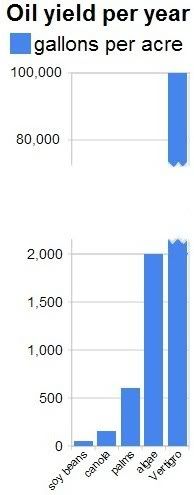 The NASA article conservatively mentions that some types of algae can produce over 2,000 gallons of oil per acre per year. In fact, most of the oil we are now getting out of the ground comes from algae that lived millions of years ago. Algae still are the best source of oil we know.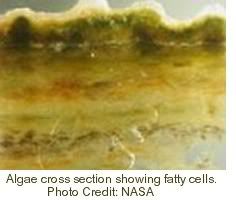
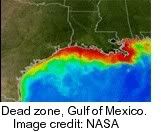 A 2007
 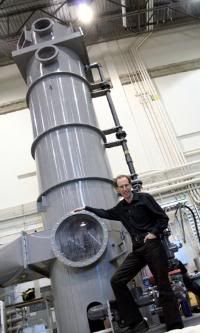 Professor David Keith (left) of the University of Calgary is working on a tower, 4 feet wide and 20 feet tall, with a fan at the bottom that sucks air in. The tower looks like it's made mainly of plastic, which could be made with carbon produced by such a tower. Inside the tower, limestone or a similar agent is used to bind the CO2 and to split CO2 off by heating it up. The limestone is recycled within the tower, although it does need to be resupplied at some stage. Anyway, the main cost appears to be the electricity to run it.